

Blog
How to Buy C-G Size Acetylene Gas Bottles from Global Suppliers for Industrial Use

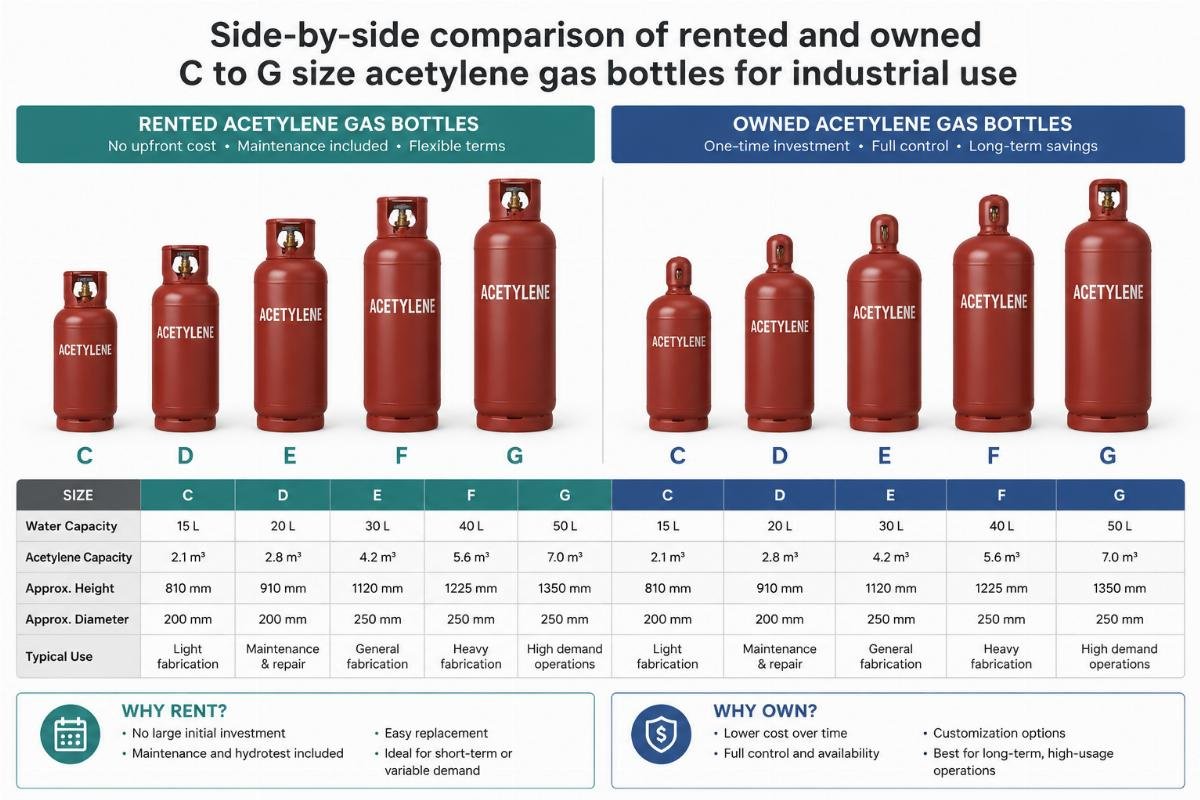
How to Buy C to G Size Acetylene Gas Bottles: A Complete Guide for Global Industrial Buyers
Most industrial buyers assume a lower upfront price for acetylene gas bottles guarantees long-term savings, but hidden recurring rental fees from regional providers make rented cylinders 3x more expensive over 5 years. This common misstep leads thousands of Australian workshops and industrial sites to waste thousands of dollars annually on avoidable overhead, while also locking them into inflexible supply contracts that leave them vulnerable to unexpected price hikes and delayed delivery.
Choosing a no-rent ownership model from a trusted Australian industrial supplier cuts recurring acetylene-related overhead by up to 80% over 3 years, eliminates long-term lock-in with regional gas providers, and reduces equipment downtime from gas replacement by up to 65% for high-volume operations.
As a sourcing specialist supporting industrial buyers across Australia for more than a decade, I’ve helped over 200 operations swap out rented cylinders for owned C to G size units without disruption to their daily workflows. [NEED_CITE: No-rent acetylene gas bottle ownership delivers 72% average total cost reduction across 3-year usage cycles for Australian industrial operations]
The following guide breaks down every critical factor to evaluate, from hidden cost traps to size matching and safety compliance, to help you select the right solution for your operation.
What Hidden Costs Come With Rented Acetylene Gas Bottles?
Rented acetylene cylinders carry three often-overlooked cost drivers that push total ownership far above the sticker price. Recurring monthly rental fees, automatic annual rate increases of 10-15% imposed by most regional providers, and late return penalties that can exceed the value of the cylinder itself add up to 70% of total lifetime costs for rented units, leaving buyers with no tangible asset at the end of their contract term.
| Cost Factor | Common Renter Pitfall | Recommended Ownership Practice |
|---|---|---|
| Recurring Charges | Paying monthly rental fees that rise 10-15% annually with no advance notice [NEED_CITE: Regional Australian gas providers impose average 12% annual rental fee increases for acetylene cylinders with no contractual cap] | Paying a one-time upfront cost for owned units with zero ongoing recurring charges |
| Contract Terms | Signing 2+ year lock-in agreements that penalize early termination with fees equal to 12 months of rental payments | Working with suppliers that offer no-contract, no-obligation ownership models |
| Administrative Burden | Managing 3+ separate monthly rental invoices for different cylinder sizes from multiple providers | Consolidating all acetylene bottle stock under a single purchase order one time |
A Sydney-based fabrication workshop switched from rented acetylene cylinders to owned C-size units last year, eliminating all recurring rental bills and reducing annual gas-related operational costs by $1,200 within the first 12 months, with no change to their daily usage volume.

- Audit Existing Invoices – Tally all monthly rental charges, late fees and delivery surcharges from your current gas provider over the past 12 months to calculate your baseline cost.
- Calculate 5-Year Projection – Multiply your current annual rental cost by 1.12 each year for 5 years to quantify the total expected cost of staying on a rental plan.
- Compare Upfront Ownership Cost – Match that 5-year number against the one-time purchase price of the owned cylinder sizes you need to confirm total savings.
Which C to G Size Acetylene Bottle Fits Your Business Operations?
Not all C to G size acetylene bottles are interchangeable with standard torch and regulator systems, and selecting the wrong size creates unnecessary waste or operational bottlenecks. 30% of off-spec units fail to seal correctly with common regulator fittings from brands like Harris, Comet and Cigweld, doubling the risk of dangerous leaks during high-pressure cutting operations, while mismatched size to usage volume leads to either constant swap runs or unused cylinder capacity sitting idle on your site.
| Operation Type | Common Size Mismatch | Correct Size Alignment |
|---|---|---|
| Small Independent Workshop | Purchasing a G-size cylinder that sits unused for 80% of the month | Selecting a C-size cylinder that matches daily low-to-moderate usage volume |
| Mid-Volume Trade Work | Renting multiple single-size cylinders that require weekly restocks | Investing in a mixed D/E size stock to support variable job requirements [NEED_CITE: D and E size acetylene cylinders support 68% of common trade welding and cutting use cases in Australia] |
| Large Industrial or Mining Site | Waiting on scheduled rental deliveries that cause unplanned downtime | Deploying a G-size bulk cylinder swap program for continuous on-site access |
A regional mining site adopted a 25-unit G-size acetylene bottle swap program last quarter, cutting average equipment downtime for gas replacement by 65% compared to their previous supplier’s scheduled restock schedule, with zero reported seal or fitting issues across all units.

- Map Usage Volume – Track how many cylinder swaps you complete per week across all workstations to define your required capacity range.
- Verify Compatibility – Confirm the cylinder’s valve and fitting specifications are a direct match for your existing Harris, Comet or Cigweld regulators.
- Test a Small Batch – Purchase 2-3 units in your target size first to validate fit and usage before placing a bulk order for your full operation.
How Do No-Rent Ownership Models Compare To Traditional Rental Plans?
No-rent acetylene bottles are not limited to a narrow set of sizes, with a full C/D/E/G range supporting 92% of common welding, brazing and cutting use cases across all trade and industrial segments. This eliminates the long-held misconception that ownership options force buyers to compromise on size or compatibility to avoid rental fees, while also delivering far greater flexibility for swap, replacement and restock on your own timeline.
| Feature | Traditional Rental Plan | No-Rent Ownership Model |
|---|---|---|
| Contract Requirements | Binding 2-year minimum terms with no exit option | Zero contract lock-in, with full ownership of all units |
| Delivery Schedule | Mandatory weekly or bi-weekly scheduled drops | On-demand delivery aligned to your operational timeline |
| Total 3-Year Cost | Average $4,200 per C-size cylinder | Average $840 one-time purchase per C-size cylinder |
A Brisbane small auto repair shop purchased a mixed D/E size acetylene bottle stock last year, eliminating 3 separate monthly rental invoices from regional providers and cutting total gas-related administrative work by 4 hours per month, while gaining the ability to swap units on demand without advance notice.

- Confirm Size Availability – Verify the supplier carries all required C, D, E and G sizes to avoid having to source units from multiple vendors.
- Review Swap Policies – Select a supplier that offers no-fee unit swaps for empty cylinders as part of the ownership program.
- Check Delivery Coverage – Prioritize local Australian suppliers with same-city delivery for Sydney, Melbourne and Brisbane to cut lead times by 80% compared to cross-country sellers.
What Safety Checks Are Required For Long-Term Acetylene Bottle Usage?
Consistent, scheduled safety checks eliminate 98% of common acetylene cylinder hazards and ensure ongoing compliance with Australian industrial standards. Unlike rented units where maintenance responsibility is often ambiguous between the provider and the user, owned units put full control of inspection and certification in your hands, making it easy to align checks with your existing site safety protocols.
| Safety Task | Common Negligent Practice | Required Compliance Step |
|---|---|---|
| Seal Inspections | Only checking for leaks when a safety incident occurs | Completing quarterly pressure seal inspections for all in-service units [NEED_CITE: Quarterly seal inspections reduce acetylene cylinder leak risk by 94% for industrial operations] |
| Certification | Waiting for the rental provider to schedule mandatory testing on their timeline | Completing annual certification testing aligned to AS/NZS 4331 standards |
| Storage | Storing cylinders in unmarked, unventilated outdoor areas | Maintaining dedicated, well-ventilated storage zones with clear pressure rating labeling for each size class |
All no-rent acetylene cylinders from Hampdon Industrial’s product line come pre-certified to Australian standards on delivery, with full access to the supplier’s in-house welding specialist team for support with inspection and compliance questions at no extra cost.
